.jpeg)

The State of Talent & Talent Technology: 2026 Ecosystem Report
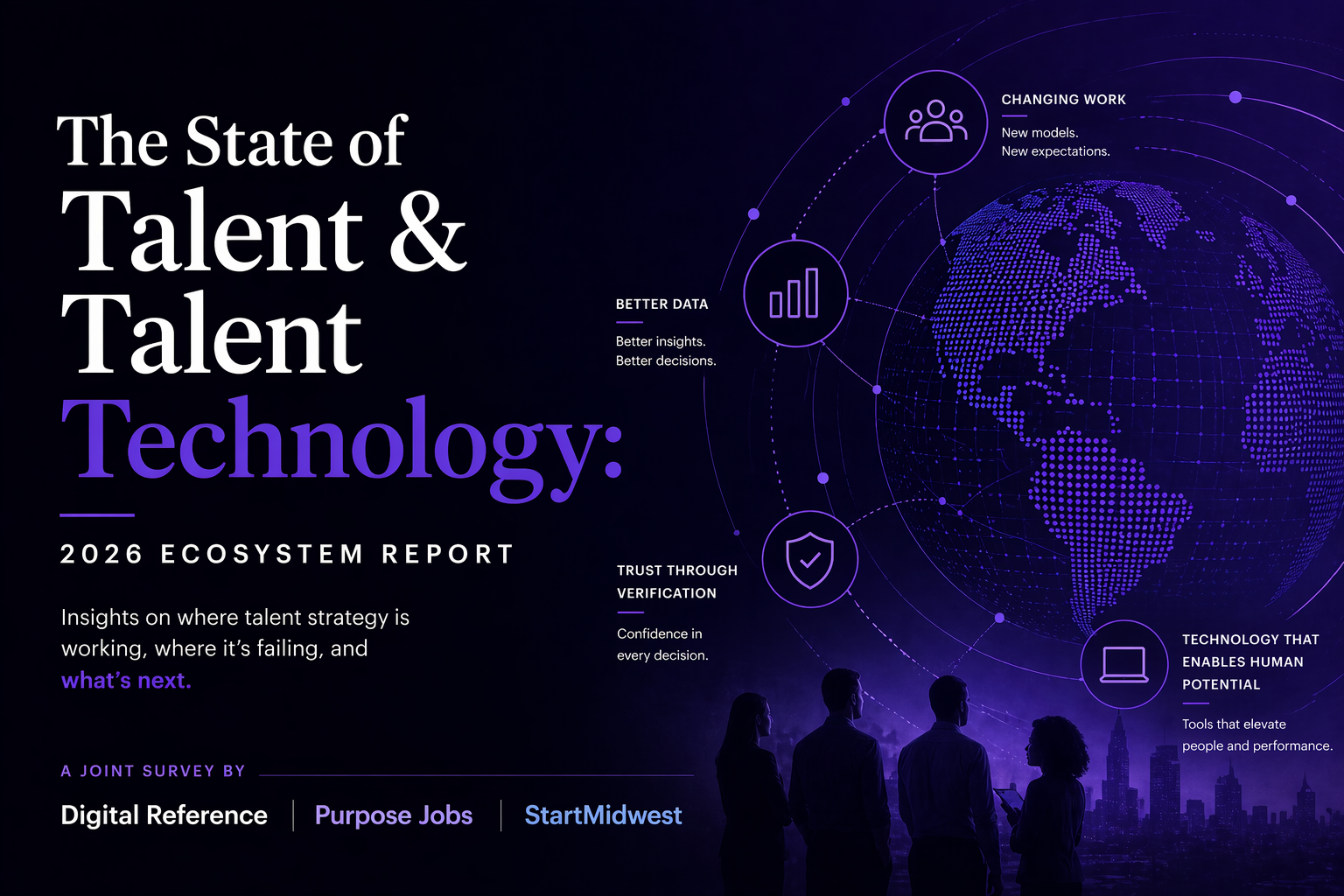
Talent & Talent Technology Report: A joint survey by Digital Reference, Purpose Jobs, and StartMidwest
Over the past decade, talent technology has dramatically improved access to candidates. Platforms have scaled, pipelines have accelerated, and sourcing has become more sophisticated. But beneath that progress, a more fundamental issue has emerged: a growing gap between how professionals present and how they actually perform.
To better understand this shift, Digital Reference partnered with Purpose Jobs and StartMidwest—two organizations deeply embedded in the talent ecosystem—to gather insights directly from hiring leaders across the United States. Each partner brings a distinct vantage point: Purpose Jobs at the intersection of purpose-driven talent and high-growth companies, and StartMidwest at the center of the region’s startup and innovation economy.
Together, this collaboration was designed to move beyond assumptions and surface what’s actually happening on the ground—how hiring decisions are being made, where they’re breaking down, and what signals can truly be trusted.
What emerged is a clear pattern:
The hiring system isn’t failing because of a lack of talent or access—it’s failing because of a lack of verification.
This report outlines the key findings shaping that reality, and points toward a new direction for how professional reputation, trust, and talent evaluation will need to evolve.
For additional survey insights see:
- State of Midwest Talent: Hiring, Workforce, and Startup Trends (2026)
- Employer Branding & Hiring Trends Report: What Candidates Expect in 2026
The Hiring System Is Broken: Verification, Not Sourcing, Is the Failure Point
Over the past decade, hiring innovation has focused on access:
- more candidates
- larger platforms
- faster pipelines
But this survey reveals a different reality:
The core problem in hiring is no longer finding talent—it’s trusting what you’re seeing.
Across industries, hiring leaders are overwhelmed with qualified-looking candidates, yet lack reliable ways to verify actual performance. The result is a system optimized for presentation, not proof.
Digital Reference operates at the center of this gap—serving professionals building career reputations and the hiring leaders responsible for evaluating them—through verified video references and structured career portfolios.
I. The “Looks Good on Paper” Problem Is Nearly Universal
When asked whether they’ve interviewed candidates who looked strong on paper but failed in reality:
- 59.5% said sometimes
- 21.4% said frequently
- 11.9% said very frequently
92.8% of hiring leaders experience this problem.
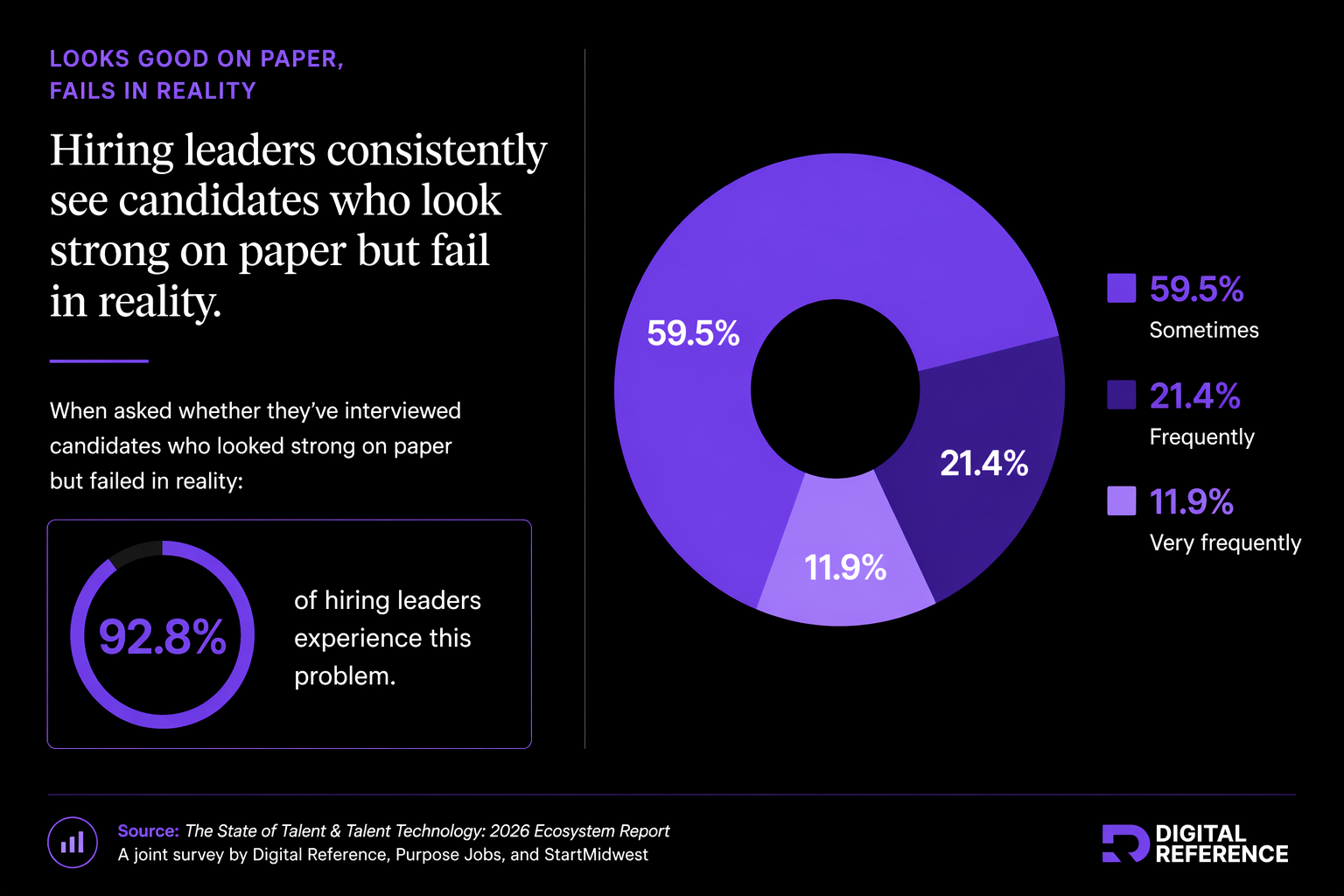
This is not an edge case—it’s the default condition of modern hiring.
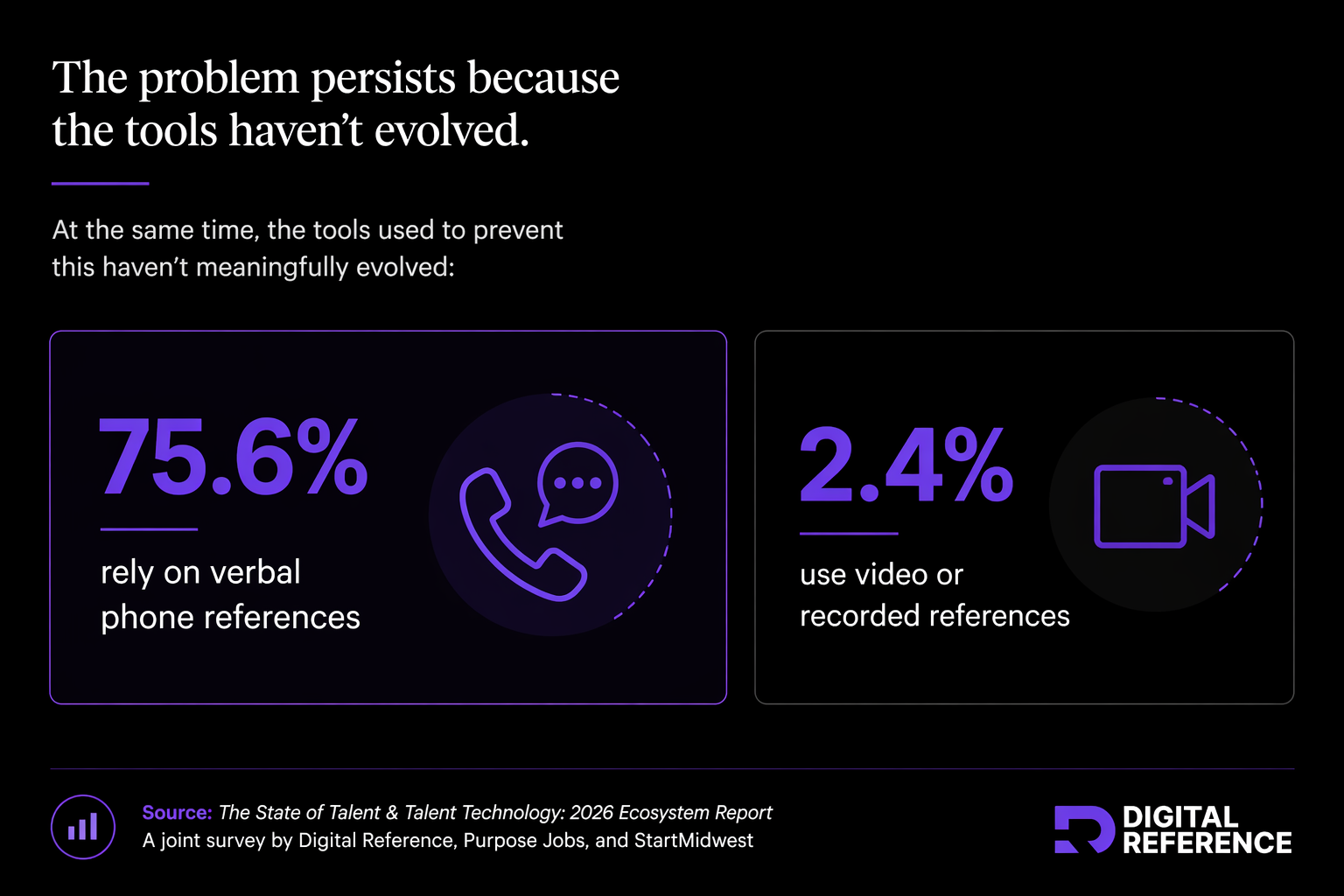
At the same time, the tools used to prevent this haven’t meaningfully evolved:
- 75.6% rely on verbal phone references
- Only 2.4% use video or recorded references
Insight:
Hiring operates in a world where nearly everyone has been burned, yet the dominant verification methods remain informal, inconsistent, and unstructured.
Implication:
The market is saturated with candidates who present well, but lacks infrastructure to validate who actually performs well.
II. References Are Trusted—but Structurally Broken
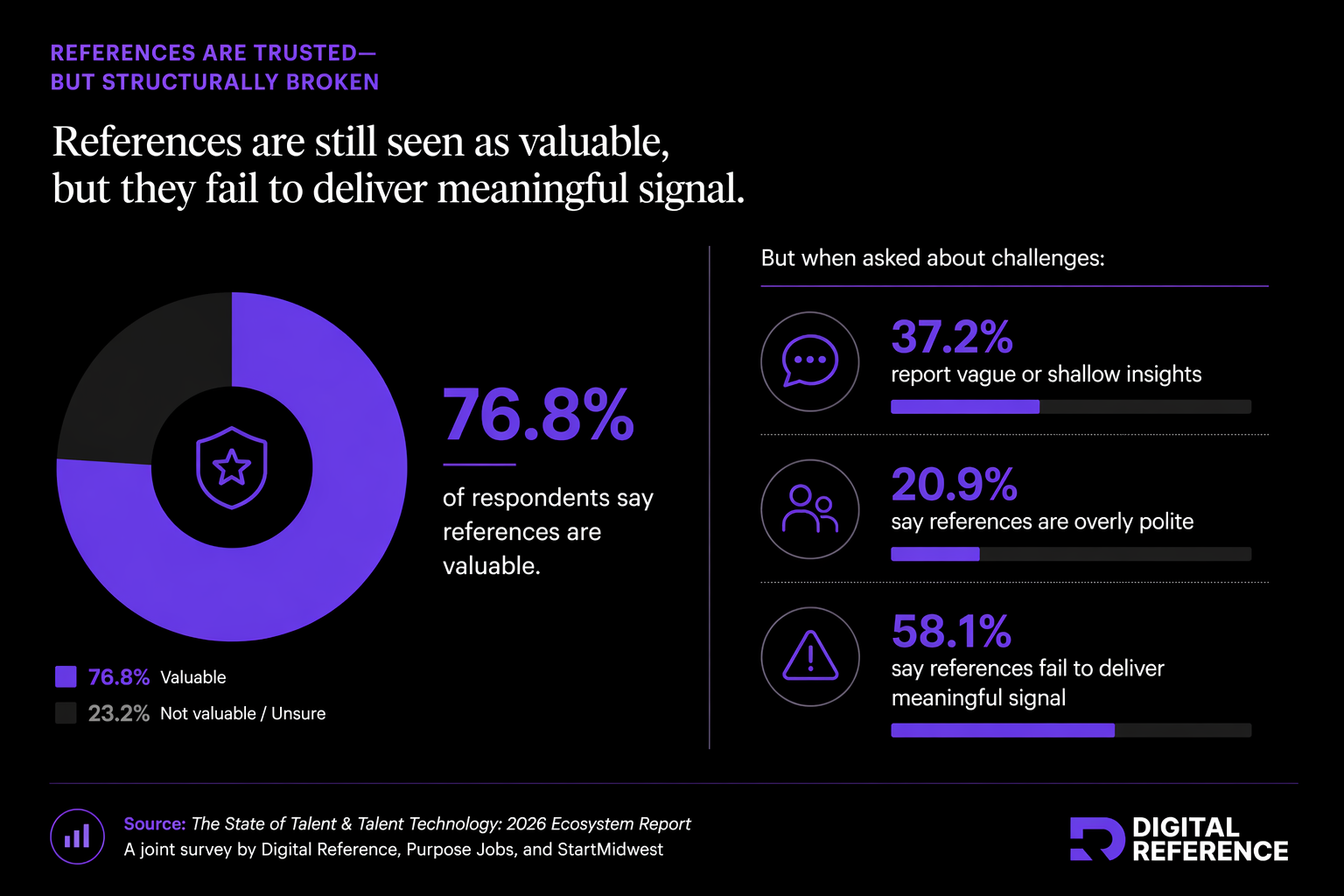
- 76.8% of respondents say references are valuable
But when asked about challenges:
- 37.2% report vague or shallow insights
- 20.9% say references are overly polite
58.1% say references fail to deliver meaningful signal.
Core Tension:
The hiring ecosystem believes in references—but cannot extract truth from them.
References today are:
- biased by design
- inconsistent in format
- collected too late to influence decisions meaningfully
Implication:
References function more as social validation theater than as a reliable verification layer.
This is Where Digital Reference Fits:
Digital Reference provides a structured, recorded, and verified reference system that directly addresses the status quo issues of:
- lack of depth
- lack of comparability
- lack of accountability
III. AI Is Accelerating the Collapse of Resume Trust
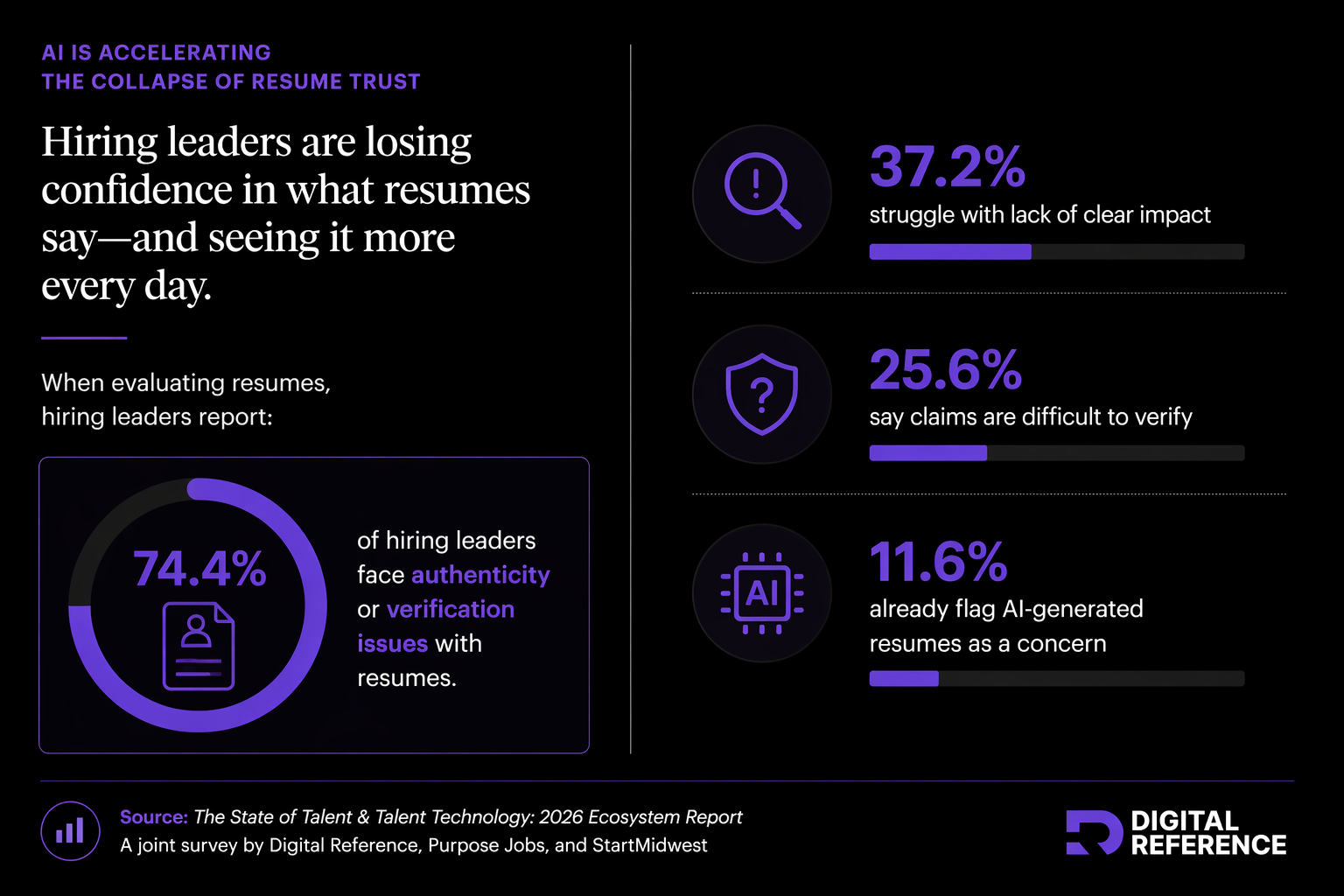
When evaluating resumes, hiring leaders report:
- 37.2% struggle with lack of clear impact
- 25.6% say claims are difficult to verify
- 11.6% already flag AI-generated resumes as a concern
74.4% face authenticity or verification issues with resumes.
Insight:
The resume—long the foundation of hiring—is rapidly losing trust.
AI has made it easier than ever to:
- optimize language
- simulate competence
- tailor narratives perfectly
Implication:
We are entering a zero-trust era for traditional candidate artifacts.
The concern around AI-generated resumes is still emerging—but it is a leading indicator of a much larger shift:
When content becomes infinitely optimizable, it stops being a reliable signal.
Where Digital Reference Fits:
Verified video references and career portfolios introduce:
- identity-backed signal
- contextual proof of work
- harder-to-fabricate credibility
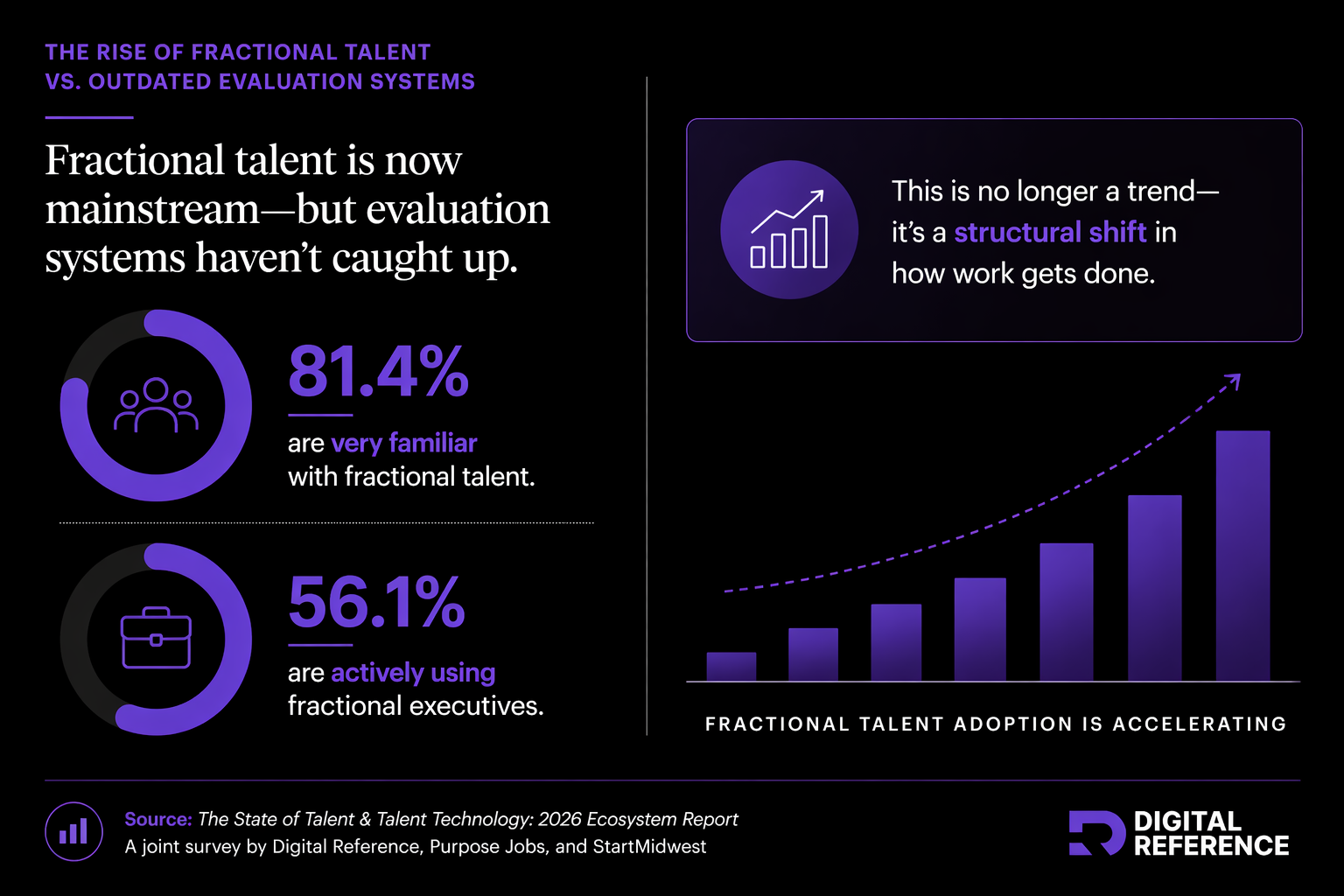
IV. The Rise of Fractional Talent vs. Outdated Evaluation Systems
- 81.4% are very familiar with fractional talent
- 56.1% are actively using fractional executives
This is no longer a trend—it’s a structural shift in how work gets done.
Yet:
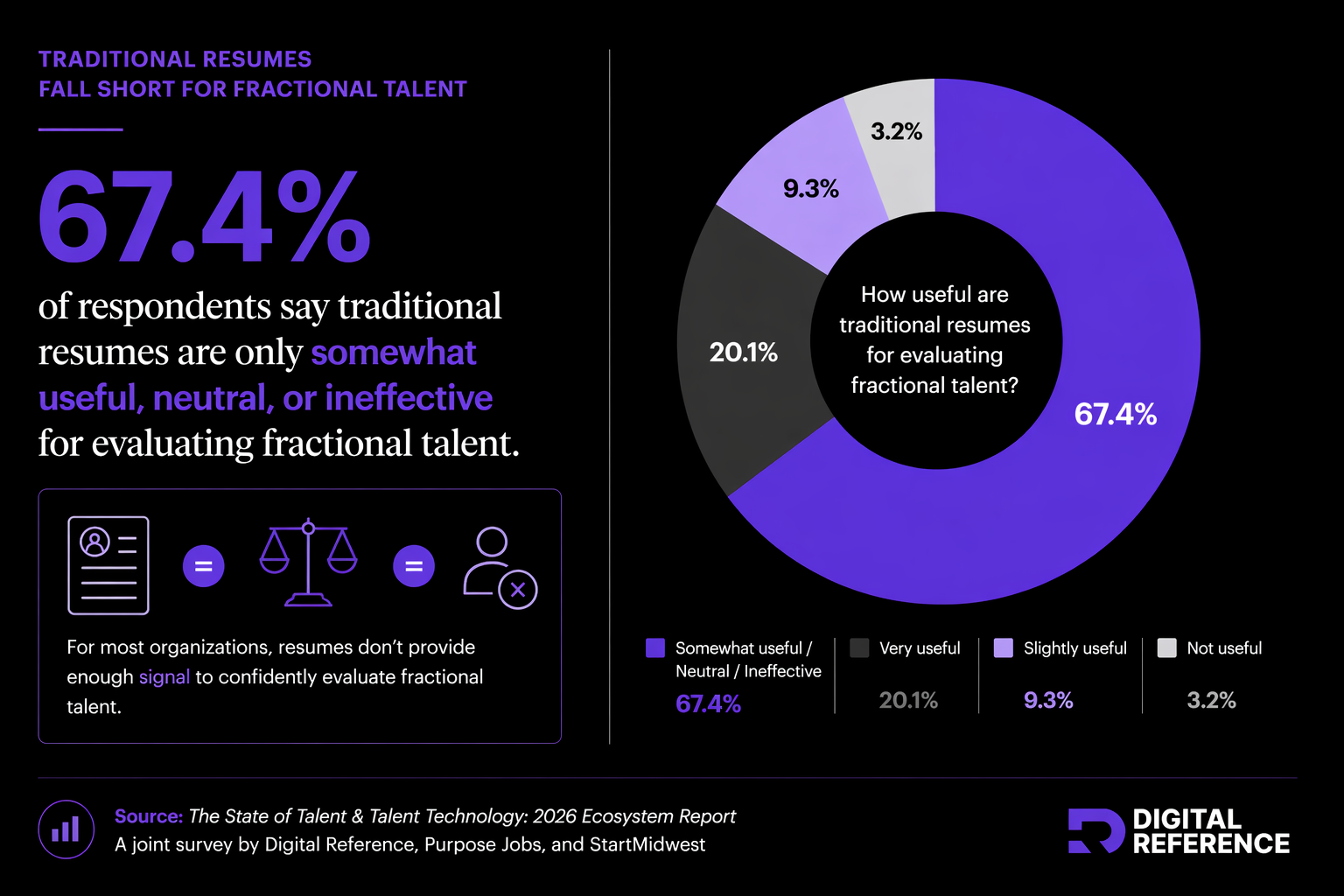
- 67.4% of respondents say traditional resumes are only somewhat useful, neutral, or ineffective for evaluating fractional talent
Insight:
The fastest-growing segment of the workforce is being evaluated with tools designed for a different era.
Traditional resumes assume:
- linear careers
- single employers
- static roles
Fractional talent operates through:
- projects
- outcomes
- multi-company impact
Implication:
There is a widening mismatch between how work happens and how it is evaluated.
V. The Verification Paradox
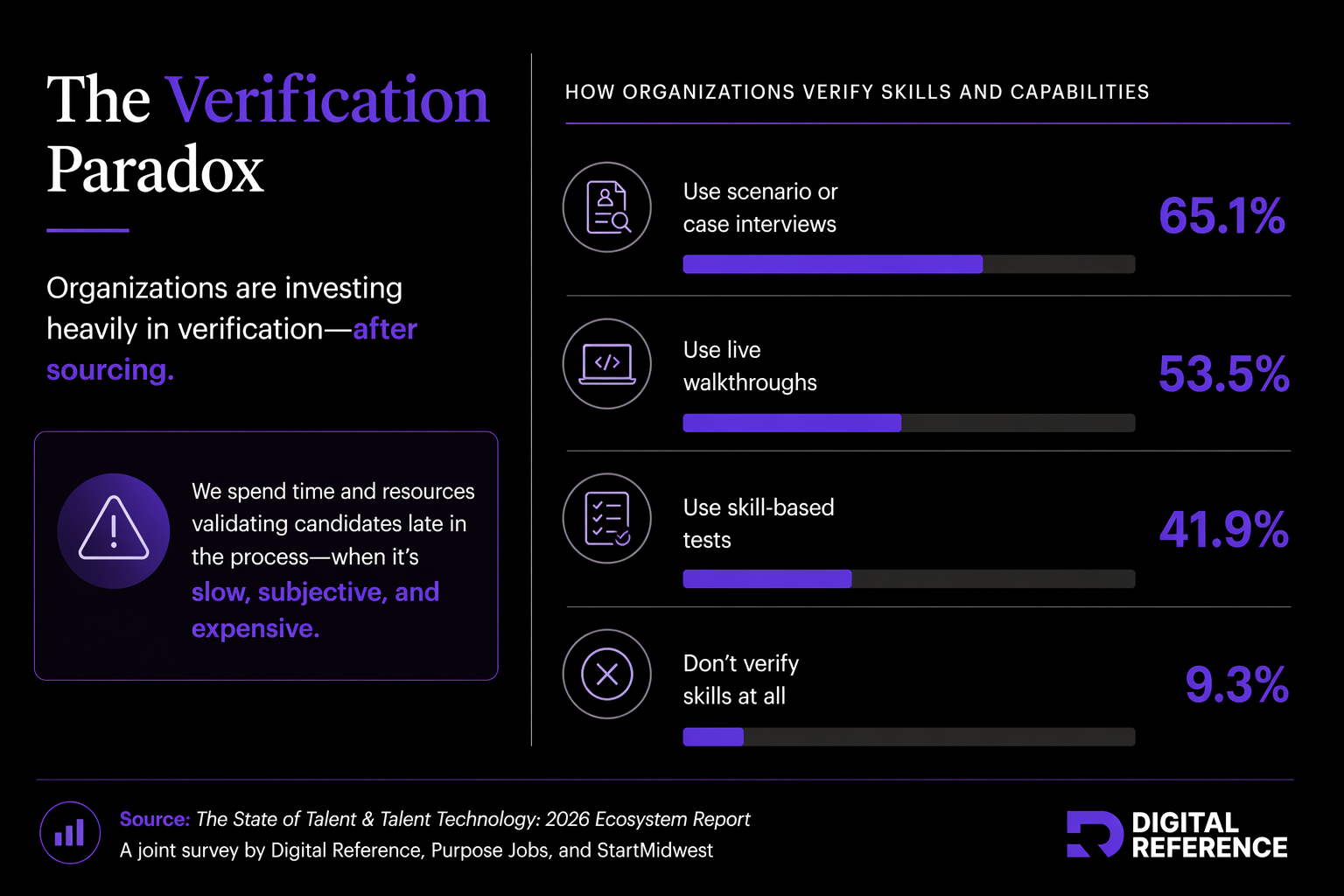
Organizations are investing heavily in verification after sourcing:
- 65.1% use scenario or case interviews
- 53.5% use live walkthroughs
- 41.9% use skill-based tests
- 9.3% don’t verify skills at all
At the same time:
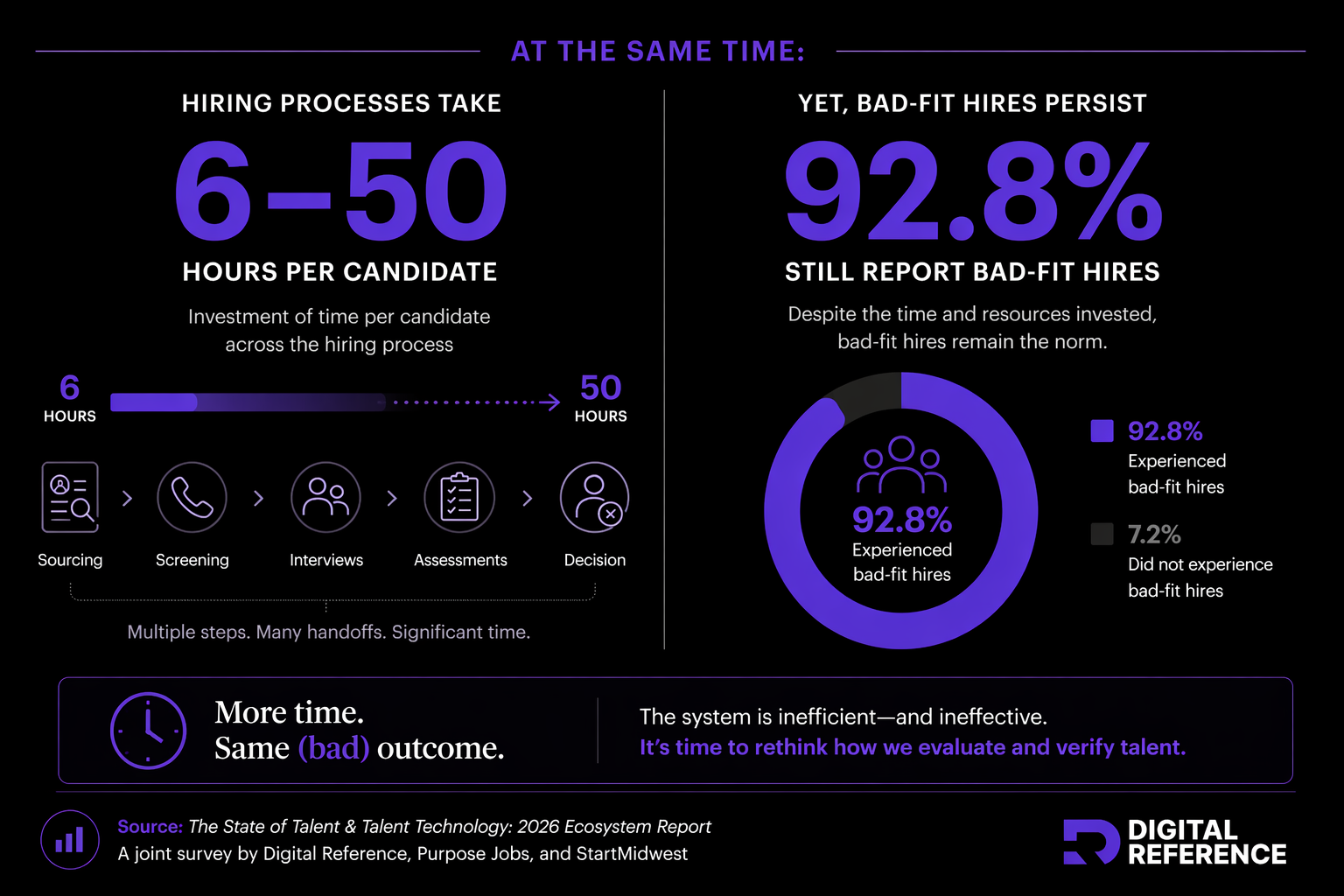
- Hiring processes take 6–50 hours per candidate
- 92.8% still report bad-fit hires
Insight:
More effort is being applied—but outcomes are not improving.
The Paradox:
Verification exists—but it happens too late, costs too much, and still lacks reliability.
Implication:
The system is attempting to solve a foundational problem (trust) with downstream effort instead of upstream infrastructure.
Where Digital Reference Fits:
Pre-verified talent profiles shift verification:
- earlier in the process
- into a standardized format
- into reusable signal
The question becomes: What if you knew before the interview?
Closing Synthesis: The Focus in Talent Processes Must Shift From Sourcing to Verification
The hiring ecosystem has already solved for access.
What remains unsolved—and increasingly urgent—is verification at scale.
Across every data point in this survey:
- candidates can present effectively
- employers cannot reliably validate
- processes are expanding without improving outcomes
This creates a structural gap:
Signals are abundant. Trust is scarce.
The next generation of talent infrastructure will not be defined by:
- bigger networks
- faster pipelines
…but by systems that make professional reputation:
- verifiable
- portable
- trustworthy
Digital Reference is built around this premise:
That the future of hiring isn’t about finding more candidates—
It’s about finally being able to trust them.
—-------------------
About the survey and survey collection process.
* This report is based on survey data from over 50 talent decision-makers across the United States, including hiring managers, executives, and founders directly responsible for evaluating talent and driving hiring outcomes. Survey Data was collected from December 2025 through March 2026. Survey respondents were not paid to complete the survey.
Subscribe to our newsletter
We'd love to have you follow our journey, learn about to new features and functionality, and get access to talent ecosystem news.