.jpeg)

Using Professional References For Visa Petitions
Why Verified Professional References Matter For Extraordinary Ability Visa Petitions
In any extraordinary ability immigration case, it is widely understood that evidence of extraordinary skills and accomplishments in a particular field of study is a must-have for any petitioners.
A patent, a publication, an above-average salary, or a leadership title all help in making a petition look strong on paper.
Now, while this type of evidence is extremely important, the USCIS is not just checking off boxes. Officers are tasked with understanding why that evidence matters and whether it actually reflects a real distinction in the relevant field of study.
That is where verified professional references come in
For O-1 visa and EB-1 visa petitions, reference letters often do quite a bit more heavy lifting than some might assume, as documentation alone can only go so far. References are helpful in the sense that they can provide context behind the accomplishments filed in the petition. If chosen properly, strong references can make an entire case more credible.
USCIS policy is also clear on this point: Letters of support can be persuasive, but they should not stand alone. The strongest letters are specific, backed by real evidence, and written by credible individuals whose identities and qualifications can be verified.
Why Do Professional References Carry So Much Weight in O-1 and EB-1 Cases?
Both O-1 visas and EB-1 petitions revolve around the same core idea:
The applicant has reached a level of distinction in their field that sets them apart from their peers.
For EB-1 extraordinary ability, the regulations require proof of sustained national or international acclaim, demonstrated through a major achievement or a combination of qualifying criteria.
USCIS also states that EB-1 beneficiaries must continue working in their field and do not need a job offer or labor certification.
For O-1 petitions, the standard focuses on extraordinary ability or achievement, supported by specific types of evidence and typically a required advisory opinion from a peer group or labor organization.
In both cases, the officer reviewing the petition is asking a rather simple question:
Does This Person Truly Stand Out In a Meaningful Way?
It is quite rare that raw evidence can answer that question entirely on its own, which is where a personal reference letter can come into play.
A strong letter helps by translating presented evidence into real-world significance, breaking down:
- Why an award is selective or respected
- Why a publication or citation record matters in context
- Why a role was critical, not just impressive on paper
- How the applicant’s work influenced others in the field
- Whether their reputation extends beyond their immediate employer or network
Surprisingly, that last point matters more than most people realize.
USCIS specifically looks at who is providing the reference, where letters from independent experts typically carry more weight than those from close collaborators or supervisors with a vested interest in the outcome.
What Separates a Strong Professional Reference From a Weak One?
A large volume of immigration letters tends to fall short in the same category:
They are well-written and polished letters, but they do not provide context beyond what the evidence already presents.
Generic praise, while nice to include in a letter, will unfortunately not do much in terms of moving a case forward. USCIS has repeatedly emphasized that letters are more persuasive when they provide concrete explanations of why the beneficiary’s work is significant, not just broad claims of excellence.
A strong reference letter should typically highlight:
- The writer’s full identity, title, and qualifications
- A clear explanation of how they know the applicant or their work
- Specific examples of contributions, projects, or achievements, and their impact
- Evidence of impact, adoption, or recognition
- Language that feels original and personal, not templated
This is where verification becomes critical.
It is less so about what the letter says on the surface and more so about whether the person behind it is real, credible, and clearly positioned to evaluate the applicant.
If USCIS cannot easily confirm who the writer is or why their opinion matters, the value of that letter can be negatively impacted.
Verified Professional References vs. Generic Recommendations
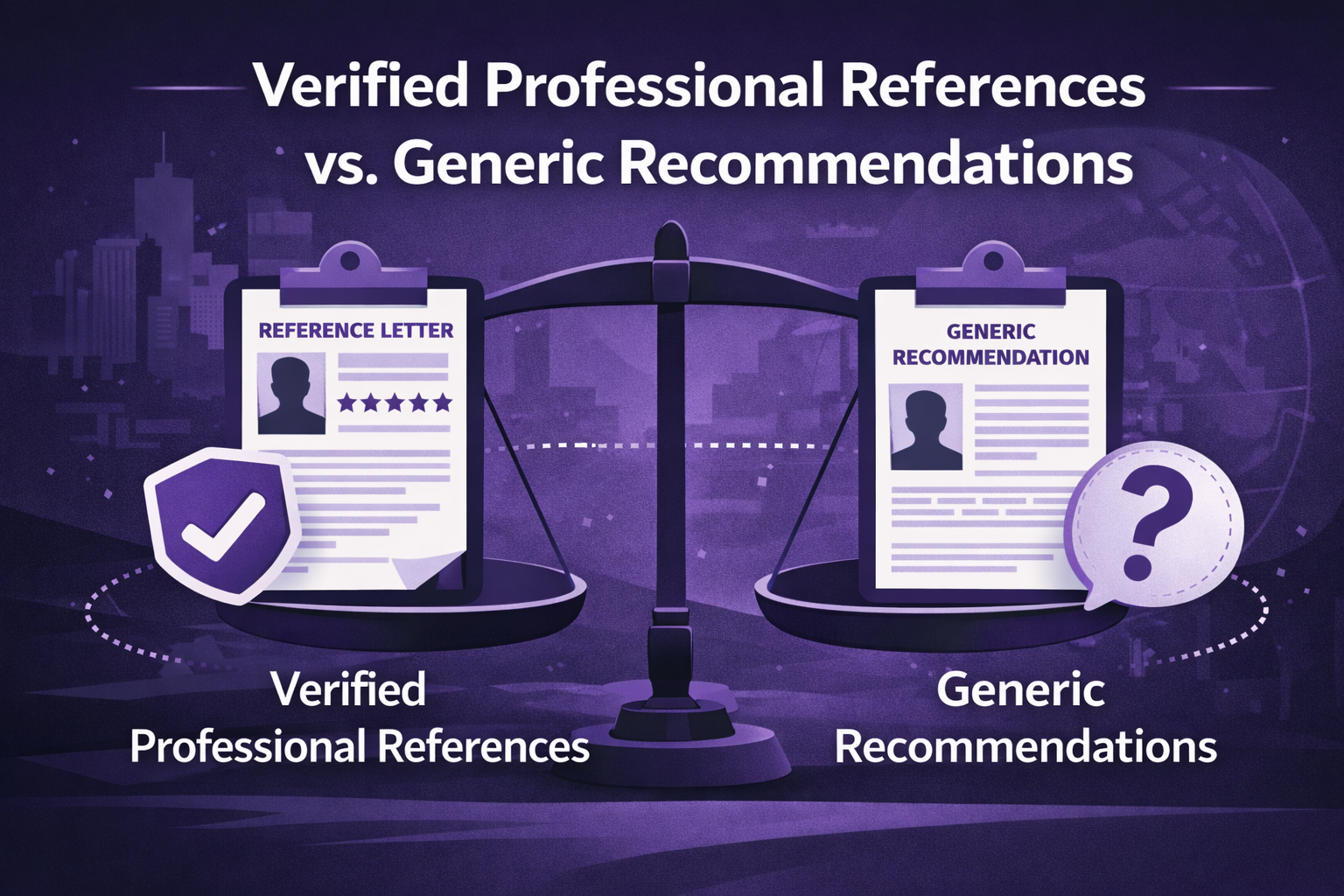
When it comes down to extraordinary ability visa petitions, there is a clear difference between a recommendation and a verified professional reference.
Where a recommendation can be supportive and well-written, a verified reference is something stronger. It comes from someone whose credentials can be verified, whose authority in the field is clear and obvious, and whose statements align with the documentary evidence in the petition.
USCIS does not evaluate letters in isolation, but rather officers will compare them directly against the rest of the record. If a letter claims industry-wide impact, there should be evidence to support that claim.
USCIS also makes it clear that letters should be corroborated by objective documentation and should not serve as the foundation of the petition.
So, in other words, reference letters should reinforce the case, not try to carry it.
Where Professional References Fit In O-1 Petitions
For O-1 visa petitions, the required advisory opinion already provides one layer of third-party validation.
The regulations state that consultation from a relevant peer group or labor organization must be submitted in writing and signed by an authorized official.
Beyond that requirement, additional reference letters can certainly help strengthen the case, and are especially useful when the petition needs to demonstrate:
- Critical roles within distinguished organizations
- Original contributions of significance
- Recognition beyond a single employer
- A reputation that extends across the field
In practice, the most effective O-1 visa petitions include a mix of perspectives, ranging from internal references that explain direct contributions to independent experts validating broader recognition.
Why Does Credibility Matter Even More In EB-1 Petitions?
EB-1 extraordinary ability cases often come down to one thing: credibility.
USCIS has updated its guidance in recent years to clarify how evidence should be evaluated. This includes how different types of documentation can meet specific criteria, which puts more pressure on the overall consistency of the petition.
A weak or exaggerated reference can raise questions about the entire filing, whereas a strong, well-supported reference can do the opposite.
For example:
- If the case relies on published material, a reference can explain why that coverage matters in the field
- If the case claims original contributions, a reference can show how those contributions were adopted or used in practice
- If the applicant held a leading role, a reference can explain why the organization is distinguished, why the role was critical, and the impact made on the organization
These compounding details are often what separates strong petitions from weak ones.
Fraud Risk And Why Verification Is Not Optional
USCIS actively investigates potential fraud through its Fraud Detection and National Security Directorate (FDNS), which reviews submitted information and conducts any necessary additional checks.
That can include, but is not limited to, document verification, background checks, and follow-up inquiries.
If reference letters appear inconsistent, recycled, or unverifiable, they can create serious issues. A strong process to follow to avoid any issues in this area typically includes:
- Confirming the writer’s current role and affiliation
- Using institutional or professional email addresses when possible
- Keeping signed copies of final letters
- Aligning statements with actual evidence in the petition
- Avoiding duplicated structure or language across letters
- Ensuring the signer has genuinely reviewed and approved the content
While some might see this as excessive, it is actually quite standard practice for strong filings.
What Does a Strong Reference Strategy Look Like?
The best petitions treat reference letters with the same importance, if not more, than every other piece of evidence they present.
Start by choosing the right mix of voices. Each reference matters and should bring something different to the table. Where one may focus on more technical contributions and leadership skills, another may address broader industry impact.
Next, make sure every letter has a clear purpose. Repetition adds volume, not strength, and that repetition can be seen as a negative mark.
Then, verify everything from titles and roles to affiliations and achievements, which should match the rest of the record exactly.
Finally, focus on authenticity. The strongest letters should read like real professionals explaining why someone stands out, not like templated documents written for immigration purposes.
The Bottom Line: Verified Professional References Can Make The Difference in Visa Petitions
In O-1 and EB-1 petitions, reference letters can not be looked at as filler.

In reality, they are often the bridge between raw evidence and real understanding, but not all references carry the same weight.
The ones that matter are verified, credible, and specific. They come from people who can be identified, whose authority is clear, and whose statements align with the broader record.
When done right, they elevate the entire petition.
When done poorly, they can undermine it.
In extraordinary ability cases, credibility is everything, and verified professional references are one of the clearest ways to build it.
Subscribe to our newsletter
We'd love to have you follow our journey, learn about to new features and functionality, and get access to talent ecosystem news.