Fractional Jobs vs Toptal: Which Platform Fits a Startup Hiring a Fractional Executive (2026)
.jpeg)

Fractional Jobs vs Toptal: Which Platform Fits a Startup Hiring a Fractional Executive (2026)
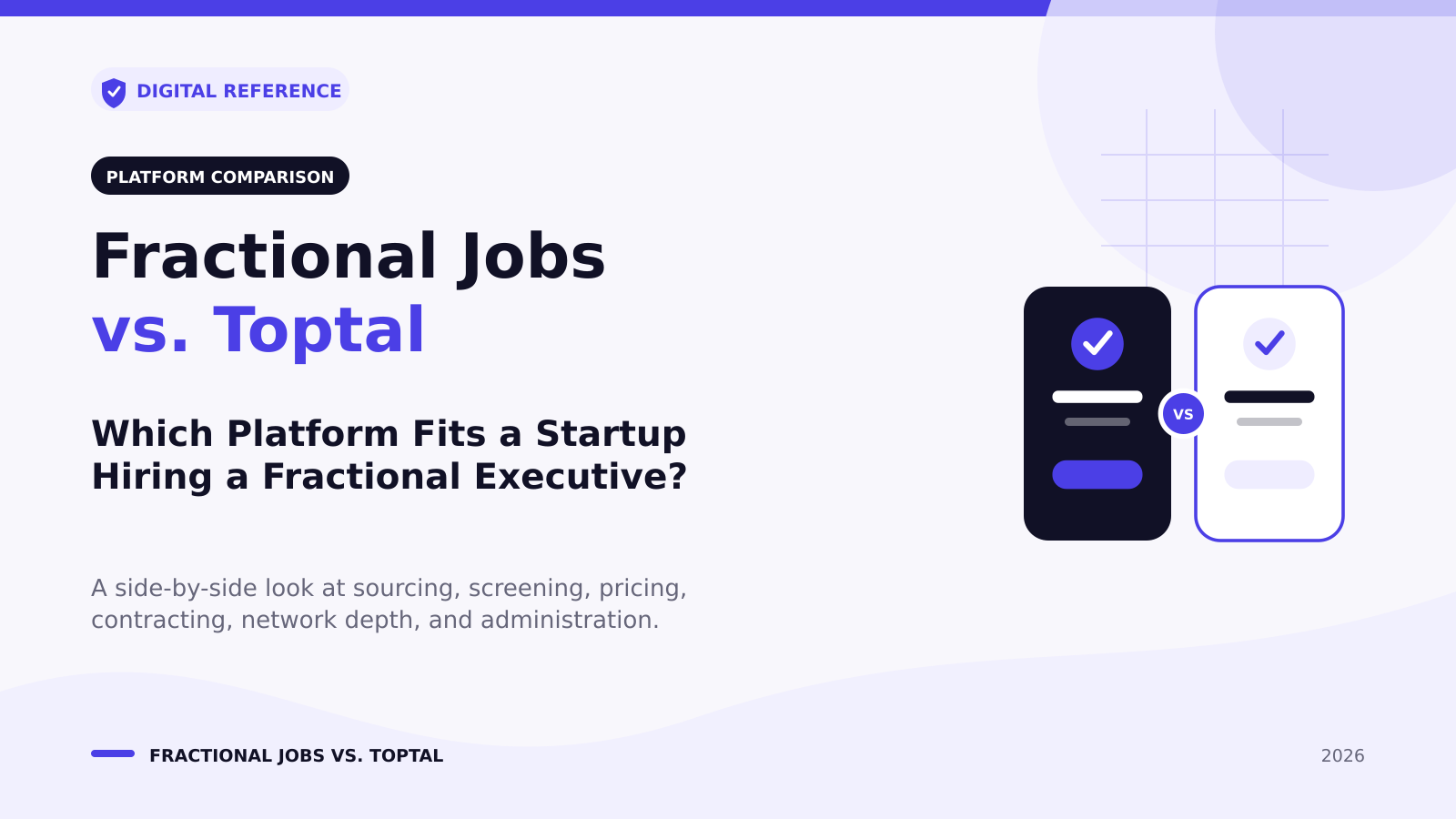
Fractional Jobs vs. Toptal
Fractional Jobs and Toptal can both connect companies with experienced independent professionals, but they approach the market differently.
Fractional Jobs focuses specifically on fractional and interim talent and uses a guided search process. Toptal operates a broader talent network across areas including technology, design, finance, product, and other professional disciplines.
For companies evaluating the two, at Digital Reference we don't think the most useful question is simply which platform is "better."
The more important question is which operating model better matches the type of person you're hiring and how much involvement you want the platform to have.
How Fractional Jobs and Toptal Differ When Matching You With a Fractional
With Fractional Jobs, the process starts with a brief.
You describe the function, company stage, and responsibilities you want the person to own. The Fractional Jobs team searches its network and develops a shortlist against those requirements. The company reports a network of more than 30,000 fractional professionals across more than 10 functions and says approximately 86% of its shortlists result in a hire.
Toptal uses its own talent screening and matching model. Companies describe what they need, and Toptal matches them with professionals from its network. Toptal is known for its selective screening process and states that fewer than 3% of applicants are accepted into its network.
Both approaches involve more curation than simply posting a job publicly and reviewing applications.
The important distinction is specialization. Fractional Jobs is explicitly built around fractional and interim work across leadership and specialist functions. Toptal serves a broader independent talent market and has established depth in areas such as engineering, design, finance, and product.
For a buyer, that means the right choice can depend heavily on the role. Someone hiring a fractional executive to own an entire function may evaluate the platforms differently from someone hiring a highly experienced specialist to execute a defined project.
What's the Difference in Cost: Fractional Jobs vs. Toptal
Fractional Jobs publishes a relatively straightforward pricing model: a one-time referral fee of either $3,000 or $5,000, payable when a company hires someone introduced through the platform.
Fractional Jobs says it does not take a percentage of the executive's compensation. The company and executive negotiate compensation directly.
Toptal's pricing works differently and varies based on the talent and engagement. Because Toptal does not publicly present its economics in the same one-time referral-fee structure, companies should request current pricing directly rather than assuming a standard markup.
That distinction is important when comparing total cost.
For example, consider a fractional CTO charging $200 per hour for 10 hours per week. That represents approximately $2,000 per week, or roughly $104,000 over 52 weeks, before any platform-related costs.
Under Fractional Jobs' published model, a $5,000 referral fee would bring the total to approximately $109,000 for the first year.
For Toptal, the appropriate comparison requires the actual rate quoted by Toptal for a comparable professional and engagement. Without that quote, assigning a definitive percentage markup or annual total would create a level of precision that isn't warranted.
This is an important consideration whenever comparing fractional talent platforms: don't compare only the executive's hourly rate. Ask what the complete cost of the engagement will be, including sourcing fees, platform fees, administrative charges, and any potential conversion costs.
Fractional Jobs' own Fractional Work Report, based on a survey of 1,733 fractional workers, reports that 46% primarily bill through monthly retainers while 23% primarily bill hourly. It also reports that a typical engagement runs approximately six to twelve months.
Those engagement lengths make fee structure an important part of the buying decision.
Rather than assuming one platform will always be less expensive, buyers should compare the total expected cost over the likely duration of their specific engagement.
The Fractional Hiring Platforms Differ on Who "Owns" the Relationship
This is one of the clearest structural differences between the two models.
Through Fractional Jobs, the company and executive establish a direct contractual relationship. Scope, hours, compensation, and future changes to the engagement are managed between those parties.
Fractional Jobs says there is no additional fee if the relationship eventually becomes a full-time hire.
Toptal remains more involved in the engagement, including contracting and invoicing. For some companies, that administrative infrastructure is a meaningful benefit.
The trade-off is that the platform remains part of the commercial relationship.
Neither structure is inherently better. A founder who wants to establish a direct, long-term relationship with an executive may prefer the Fractional Jobs approach. A company that wants more administrative infrastructure around independent talent may place greater value on Toptal's model.
When Choosing a Platform, You're Also Choosing Their Curated Talent Pool
Fractional Jobs positions its network around professionals who have already operated at a senior level, including C-suite executives, VPs, directors, and senior specialists.
The company reports coverage across more than 10 functions, including finance, marketing, operations, HR, technology, legal, security, medical, and compliance leadership. Approximately 85% of the network is based in North America, according to Fractional Jobs.
The company says US-based professionals in its network generally charge approximately $100 to $500+ per hour, depending on the role and experience required.
Toptal's network serves a broader independent talent market and is particularly well known for professional talent in areas such as software engineering, design, finance, and product.
That broader scope can be an advantage when a company needs both strategic and execution-oriented talent.
The distinction I would focus on isn't simply which platform has "better" professionals. It's whether the platform has meaningful depth in the specific function, seniority level, industry, and type of engagement you're trying to fill.
For any important fractional hire, those questions are more useful than the total size of a platform's network.
Each Fractional Hiring Platform Has Real Strengths to Consider
Fractional Jobs fits better for hiring when
- You are specifically looking for fractional or interim leadership.
- You want the platform to conduct the initial sourcing process for you.
- You prefer to contract with and manage the executive directly after the introduction.
- You value knowing the platform's referral fee upfront.
- There is a possibility that the fractional relationship could eventually become a full-time role.
- You are searching in a specialized leadership function such as operations, HR, legal, compliance, or security in addition to more common fractional categories.
- You don't need a third party to manage ongoing contracting and invoicing.
Toptal fits better for hiring when
- You need experienced independent talent across engineering, design, finance, product, or another area where Toptal has established depth.
- Your need is as much about specialized execution as it is about fractional leadership.
- You value having a platform involved in contracting and invoicing.
- You want access to a broader independent talent ecosystem rather than a platform focused specifically on fractional work.
- Administrative convenience is an important part of what you're looking for from the platform.
Deciding Between Toptal and Fractional Jobs
Fractional Jobs and Toptal solve overlapping problems, but I see them as representing two different approaches to independent professional talent.
Fractional Jobs is more specifically oriented toward fractional and interim professionals. Its guided-search process, one-time referral fee, and direct contracting model can make it particularly relevant for startups and growing companies looking for someone to take ownership of a function.
Toptal operates across a broader professional talent market and provides more of the infrastructure around the engagement itself. That can be attractive when a company values screening, matching, contracting, and administration within a single platform.
If I were evaluating the two as a founder, I would start with the work rather than the platform.
Do I need someone to own a function, or execute a project?
Do I want a direct relationship with that professional, or do I want a platform to remain involved?
How long do I expect the engagement to last?
What is the complete cost—not just the advertised fee or hourly rate?
Those answers will usually make the choice clearer.
At Digital Reference, that's also how we think buyers should approach the growing fractional talent ecosystem. The market is becoming large enough that there isn't one platform that needs to win every use case. What's increasingly important is giving companies enough transparency around professionals, experience, pricing, and engagement models to choose the right person and the right way to work with them.
Frequently Asked Questions When Choosing Between Fractional Jobs and Toptal
Is Fractional Jobs cheaper than Toptal?
It depends on the specific engagement.
Fractional Jobs publishes a one-time referral fee of $3,000 or $5,000 and says it does not take an ongoing percentage of the executive's compensation. Toptal's pricing varies based on the talent and engagement.
For an accurate comparison, companies should request a quote for comparable talent from both platforms and calculate the total expected cost over the anticipated duration of the engagement.
Who employs the executive in each case?
Through Fractional Jobs, the professional contracts directly with the hiring company.
Through Toptal, the engagement is facilitated through Toptal's platform and contracting infrastructure.
Companies should confirm the specific contractual terms associated with any engagement before hiring.
Can a Fractional Jobs or Toptal placement become a full-time hire?
Fractional Jobs says a professional introduced through its platform can transition into a full-time relationship without an additional conversion fee because the company and professional already contract directly.
Companies considering a similar transition through Toptal should confirm the current conversion terms associated with their specific engagement.
Which is better for hiring a fractional CFO or CTO?
Either platform may produce strong candidates, and the better choice depends on the specific role and engagement.
Fractional Jobs is specifically built around fractional professionals across multiple leadership functions, while Toptal has a broad network with established depth in areas including technology and finance.
For a fractional CFO or CTO search, companies should compare the candidates presented by each platform based on relevant operating experience, company stage, industry knowledge, availability, references, and the responsibilities the person will actually own.
Can a company use both?
Yes.
The platforms aren't mutually exclusive, and a company could use different talent sources for different needs. For example, a business might use one source to identify a fractional executive responsible for a function while using another marketplace to find specialized professionals supporting execution underneath that leader.
The more important consideration is making sure responsibilities are clearly defined and that each professional's experience aligns with the work they're being hired to perform.
Using Digital Reference to Find the Right Platform For Hiring Fractionals For Your Needs
Choosing the right platform is only one part of making a successful fractional hire.
You also need to define the role clearly, determine the kind of leadership your business needs, and evaluate candidates based on relevant experience—not simply their title.
Explore these Digital Reference resources as you continue your search:
- Best Platforms and Marketplaces to Hire a Fractional Executive compares leading options and explains the types of companies and engagements each platform may suit.
- Best Platforms to Find and Hire A Fractional CMO : compare best in class platforms for finding a fractional CMO.
- How to Hire a Fractional Executive: A Guide for Founders and Operators covers when to hire fractionally, what to look for in candidates, and how to structure a productive engagement.
- When to Hire a Fractional Executive vs. a Consultant can help you determine whether you need an embedded leader who owns execution or an outside advisor focused on a specific challenge.
If you already know which function you need, you can also explore Digital Reference’s specialized directories to:
Subscribe to our newsletter
We'd love to have you follow our journey, learn about to new features and functionality, and get access to talent ecosystem news.